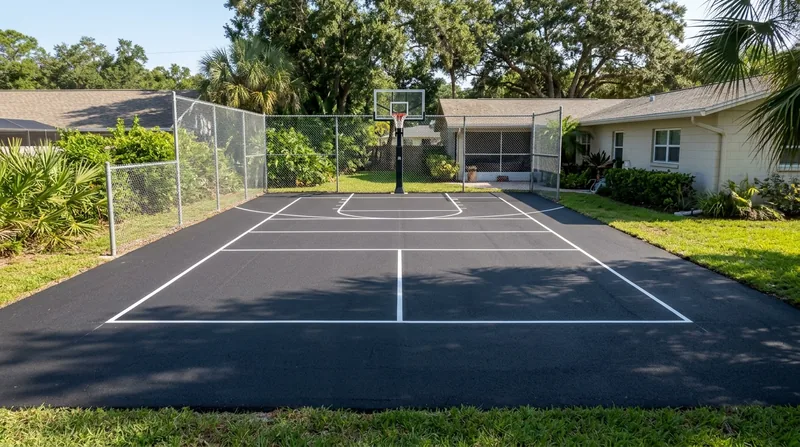




A backyard basketball or tennis court in Tampa needs more than a flat surface. The fine sand that runs under most of Hillsborough County gives little to bear on unless it is confined and compacted, and the near-daily afternoon thunderstorms of the rainy season push water sideways across flat ground. The water table itself rises underneath, and the intense Gulf Coast sun oxidizes and softens asphalt between storms. Sports court and path paving in Tampa means grading and compacting a stable base, then finishing with hot mix so the court plays flat through summer storms and doesn't become a puddle when the rain stops. We build courts that hold their surface and their pitch, year after year.
Why Sports Court and Path Paving Matters in Tampa's Climate
Tampa's terrain and weather create specific demands for any court surface. The high water table and porous limestone below mean the base has little structural support unless it is confined and compacted. A court that sheds water fast is the only thing standing between a playable surface and a wet, slippery hazard. Summer storms arrive predictable and hard, and the Gulf Coast sun works on asphalt constantly, oxidizing the binder and softening the mix between storms. A poorly built court fails not from one catastrophic event, but from the slow work of water and heat.
- We grade and compact the base so water drains away instead of pooling under the court.
- We lay hot mix thick enough to handle the traffic and the thermal stress of Tampa summers.
- We pitch the court carefully so every storm sheds water fast and the base stays dry.
- We confine the edges so the sand beneath never gets the chance to wash or settle away.
- We finish the surface so it plays flat and true through years of use and weather.
A court built this way keeps its surface and stays playable when poorly built courts become hazards.
Local example: A residential court in Seminole Heights or Carrollwood laid on fine sand without proper base preparation fails within two to three years as the sand settles and the surface cracks. A court built with confined and compacted base, proper pitch, and adequate thickness can serve fifteen years or more with routine maintenance.
Hillsborough County and the City of Tampa regulate impervious surfaces and stormwater runoff on residential property. Check with your local building department before work begins, and verify any HOA architectural standards that govern the court or the apron around it. See Hillsborough County Public Works for local permitting rules.
How We Build a Sports Court or Path in Tampa
The work starts with the ground. We visit the site, measure the space, and assess the drainage and the existing grade. We mark out the court or path, call for a Florida 811 utility locate (required by law before any excavation), then begin the base work. Grading and compaction are where the durability lives. A court that plays flat and sheds water fast is built from the ground up, not from the surface down.
- We measure the site and assess drainage, grade, and soil conditions.
- We call for a Florida 811 utility locate and verify the results on site.
- We grade the court to the proper pitch, removing high spots and filling low areas.
- We compact the base in lifts, using a plate compactor or roller to achieve proper density.
- We lay hot mix asphalt in the thickness required for the court's use and the local climate.
- We finish and compact the surface, leaving it smooth, flat, and pitched to drain.
The entire process, from grading to finish, typically takes two to five days depending on site size and weather. The new asphalt must cure for six to twelve months before applying any sealcoating.
Real project: A basketball court in Wesley Chapel required removal of a failed recycled-millings apron, grading and compacting of the base, and a new 2.5-inch asphalt court surface pitched for drainage. The work took three days. The court now sheds storms and plays flat through Tampa's summer heat.
If the court needs to tie into an existing driveway or apron, we handle the transition and ensure the pitch flows correctly across both surfaces. See our work on driveway extensions and aprons for more detail on how we handle these connections.
Sports Court and Path Paving Methods in Tampa
| Approach | Description | Best for |
|---|---|---|
| New Court on Existing Grade | Grade and compact the existing soil, lay base stone if needed, then finish with hot mix asphalt. | Flat or gently sloped lots where the existing grade is sound and drainage is adequate. |
| Court with Base Replacement | Remove failed base material, re-grade, compact new base stone in lifts, then lay hot mix finish. | Sites with poor drainage, settlement, or contaminated soil that must be removed and replaced. |
| Path Overlay | Mill or grind the existing surface, profile it for drainage, then lay a new wearing course of hot mix. | Existing paths or walkways with sound base and minor surface wear that do not need full replacement. |
| Court with Permeable or Alternative Base | Grade and compact recycled asphalt millings or crushed stone, then finish with hot mix or tar and chip. | Projects where stormwater retention or environmental considerations favor permeable bases or recycled materials. |
| Full-Depth Court Replacement | Remove all failed asphalt and base, excavate to proper depth, compact new base stone, and lay new hot mix. | Courts with structural failure, poor drainage, or base settlement that cannot be repaired by overlay or patching. |
Each method is chosen based on site conditions, the cause of any existing failure, drainage requirements, and the intended use. We assess the site on a free visit and recommend the approach that will hold longest and cost least.
Sports Court and Path Paving Cost in Tampa: What to Expect
A new residential basketball or tennis court in Tampa typically starts at $8,500 and rises based on site size, existing grade, base conditions, and drainage requirements. A 2,500-square-foot court on a site that requires minimal grading and has good drainage may fall near the lower end. A court on a site with poor drainage, settlement, or contaminated soil that must be removed and replaced will cost more. A path or walkway typically costs less than a full court because it is narrower and may not require the same structural base.
The cost of the work depends on several concrete factors:
- Site size: a larger court requires more material and more labor to grade and compact.
- Existing conditions: poor drainage, settlement, or failed base material must be removed and replaced, adding cost.
- Grade change: a site that requires significant cut or fill costs more than a site with minimal grading.
- Base preparation: sites with fine sand or poor drainage may need deeper base stone or more compaction.
- Surface thickness: a court built for heavy use or in a high-traffic area may need thicker asphalt.
- Access and equipment: a site with tight access or obstacles may require smaller equipment, adding time and cost.
We provide a free, written estimate on site, with tonnage and thickness specified. The estimate includes a site visit, measurement, and a detailed breakdown of materials and labor. Get two or three estimates from different contractors so you can compare scope, materials, and price. See our pricing page for more detail on how we structure estimates and what to expect at each price point.
Call us at (813) 694-3026 to schedule a free estimate. We respond within 24 hours.
Sports Court and Path Paving Near Me: What Tampa Homeowners Should Know When Hiring
Choosing a paving contractor is one of the largest purchases a homeowner makes on the property. The single strongest trust signal in this trade is being verifiably local, because the historic fraud in driveway and court paving is the itinerant door-to-door crew with out-of-state plates and a story about leftover asphalt from a job nearby. We have been in business in Tampa since 2012, and our address and plates are here. Honest guidance is what sets a local shop apart: a contractor who proposes repair or resurfacing before replacement when the work justifies it, and who explains why.
When you call a contractor for a free estimate, here is what to verify:
- Ask whether the contractor is fully insured and request a certificate of insurance that covers the work you are having done.
- Get a written estimate that includes the site address, the scope of work, the materials to be used, the thickness of asphalt, and the tonnage or square footage.
- Check whether the contractor has pulled a free Florida 811 utility locate and verified the results on site before any excavation begins.
- Ask about the contractor's experience with sports courts and paths in Tampa's climate and soil conditions.
- Verify whether your HOA or the City of Tampa requires a permit for the work, and ask the contractor how they handle permitting.
- Call two or three other contractors and compare estimates, scope, materials, and price.
- Ask for references from recent court or path projects in Tampa and call them.
Do not hire a contractor who shows up unsolicited, demands a large cash deposit, offers a price that seems too good, or refuses to put the estimate in writing. These are red flags for fraud. A reputable local contractor will provide a free estimate in writing, with tonnage and thickness specified, and will explain the work clearly so you understand what you are paying for.
We are here to help you navigate the process. Contact us for a free estimate, or call (813) 694-3026. We will visit the site, measure the space, assess the conditions, and provide a written estimate with no obligation to book. We serve Tampa, St. Petersburg, Clearwater, Brandon, Riverview, Largo, Pinellas Park, Wesley Chapel, Land O' Lakes, Carrollwood, Town 'n' Country, Westchase, Palm Harbor, Dunedin, New Port Richey, Lakeland, Bradenton, Plant City, Valrico, and Apollo Beach.
If you have questions about asphalt driveway paving, parking lot paving, or other services, visit our homepage or call. We are happy to help.
Sports Court & Path Paving in Tampa: Pricing Guide
| Service | Price | Details |
|---|---|---|
| Residential Sports Court (2,500 sq ft) | Starting at $8,500 | New court on existing grade with proper base compaction, pitch, and 2.5 inch hot mix finish |
| Path or Walkway (per 100 linear feet, 4 ft wide) | Starting at $1,200 | New path with base preparation, compaction, and 2 inch hot mix finish, includes pitch for drainage |
| Court with Base Replacement or Drainage Work | On estimate | Site with poor drainage, settlement, or failed base material requires on-site assessment before pricing |
| Court Overlay or Resurfacing | Starting at $4,500 | Existing court with sound base and minor surface wear, milled and finished with new hot mix layer |
| Travel and Site Visit | Included | Free estimate and site assessment throughout Tampa and surrounding Hillsborough, Pinellas, and Pasco counties |
| Estimate | Free | Written estimate with tonnage and thickness specified, response within 24 hours at (813) 694-3026 |
Indicative pricing, the exact cost depends on square footage, finish, and site access. Free personalized estimate within 24h at (813) 694-3026.


